

How to Choose an Immunotherapy Hospital in Delhi: A 10-Point Checklist
Quick answer: The best immunotherapy hospital in Delhi for you is one where a qualified medical oncologist leads your care, tumour biomarker testing is done before treatment, immune-related side effects can be managed around the clock, and the full cost is explained in writing. Use the 10-point checklist below to compare any hospital or clinic in Delhi NCR.
Key takeaways
- Immunotherapy should be planned by a qualified oncologist, ideally through a multidisciplinary tumour board.
- Biomarker tests (such as PD-L1 and MSI) should come before the treatment decision, not after it.
- Choose a centre that can handle immune-related side effects quickly, including at night and on weekends.
- Ask for a written, itemised cost estimate for the full course.
- A second opinion is normal and sensible before starting expensive treatment.
Why choosing the right centre matters
India recorded an estimated 14.6 lakh new cancer cases in 2022, and the number is projected to rise further, according to the ICMR’s National Cancer Registry Programme.
Delhi NCR has some of the country’s largest cancer centres, as well as many smaller clinics offering immunotherapy. With so many choices, and costs that can run into lakhs of rupees, it helps to know what to look for.
Immunotherapy is different from chemotherapy. It works through the immune system, its side effects can appear weeks or months later, and its responses can look unusual on scans. Experience matters at every step.
10-point checklist for choosing an immunotherapy hospital in Delhi
1. A qualified oncologist leads your care
Your treatment should be planned by a specialist oncologist, such as a medical oncologist with DM or DNB training, or a radiation or surgical oncologist working within a cancer team. Ask who will be responsible for your care day to day.
2. Your case is discussed by a tumour board
Good centres review each new case in a multidisciplinary tumour board, where surgeons, medical and radiation oncologists, radiologists and pathologists decide together. Ask whether your case will be discussed and whether you will receive the written recommendation.
3. Biomarker testing comes first
Whether a checkpoint inhibitor is likely to work often depends on tests on your tumour tissue, such as PD-L1 (TPS or CPS), MSI/MMR and sometimes TMB. Lung cancers also need EGFR, ALK and related testing. A centre should order or review these before recommending immunotherapy.
4. The treatment options are explained clearly
Immunotherapy is a family of treatments, including checkpoint inhibitors, CAR-T cell therapy and dendritic cell therapy. Ask which type is being recommended, why, what the evidence shows for your cancer, and how it fits with surgery, chemotherapy or radiation.
5. Side effects can be managed around the clock
Immune-related side effects, such as colitis, pneumonitis, hepatitis or hormone problems, need prompt recognition and treatment, often with steroids. International guidelines from ASCO set out how these should be managed.
Ask: Whom do I call at 2 a.m. if I develop diarrhoea or breathlessness? The centre should have a clear emergency pathway.
6. Accreditation and safety standards
Hospital accreditation, such as NABH in India, signals that the facility follows defined standards for patient safety and infection control. For cell-based therapies, also ask about the laboratory where the cells are processed and the quality checks done on each batch.
7. Day-care and follow-up are convenient
Most immunotherapy is given as an outpatient infusion every few weeks over many months. Consider travel time across Delhi NCR, parking, waiting times, and whether some services, such as blood collection, can be done at home.
8. The cost estimate is transparent and written
Ask for an itemised estimate covering the drug or cell therapy, day-care charges, blood tests, scans, consultations, and likely side-effect management. Check whether the price is per dose, per cycle or for the full course. See our immunotherapy cost guide and Keytruda price guide for typical figures.
9. Help with insurance and financial support
A good centre’s help desk can guide you through insurance pre-authorisation, government schemes such as CGHS or Ayushman Bharat PM-JAY (at empanelled hospitals), and charitable or crowdfunding support. See financial assistance for cancer patients.
10. Second opinions are welcome
Before starting expensive or long treatment, a second opinion is common and sensible. A confident team will welcome it and share your reports readily.
Questions to ask at your first appointment
- What type and stage is my cancer, and what are my biomarker results?
- Which immunotherapy are you recommending, and why for me?
- What results can I realistically expect, and how will we measure them?
- What side effects should I watch for, and whom do I call?
- How long will treatment last, and what is the full cost?
- How does this fit with my surgery, chemotherapy or radiation?
Our guide to what to expect at your first immunotherapy consultation goes through this step by step.
Public and private options in Delhi
Delhi has large public cancer centres, including the Dr. B.R.A. Institute Rotary Cancer Hospital at AIIMS and the Delhi State Cancer Institute, as well as many private hospitals and specialised clinics across Delhi NCR.
Public centres are lower in cost but often have long waiting lists. Private centres usually offer shorter waits at a higher price. Whichever you choose, the checklist above applies.
What does immunotherapy cost in Delhi?
Costs depend far more on the type of immunotherapy than on the city. As a guide from published sources in 2026:
- Checkpoint inhibitors: roughly ₹28,950 per 100 mg vial for a nivolumab biosimilar, up to ₹3.4–4.3 lakh per cycle for branded pembrolizumab (drug only).
- CAR-T cell therapy (for certain blood cancers): usually ₹30–40 lakh or more for the treatment.
- Dendritic cell therapy: priced per dose or per course. See our dendritic cell therapy cost guide.
Denvax in Delhi
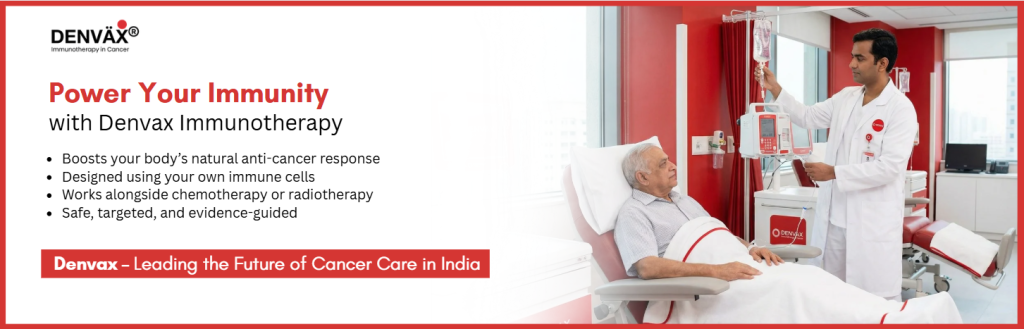
Denvax’s head office and clinic are at 63 & 18 Poorvi Marg, Vasant Vihar, New Delhi. Denvax provides personalised dendritic cell immunotherapy made from the patient’s own blood, as an add-on to standard treatment. We work alongside your oncologist rather than replacing them.
- Our doctors review your reports before your visit, and can also review them remotely.
- Blood collection and treatment are available at the clinic or at home in Delhi NCR.
- You receive a written treatment plan and cost estimate before you start.
Visit our Denvax Delhi clinic page, book a consultation, or call 1800 123 1132 (toll-free).
Frequently asked questions
Which is the best hospital for immunotherapy in Delhi?
There is no single best hospital for everyone. The right centre for you has a qualified oncologist leading care, does biomarker testing before treatment, can manage immune side effects around the clock, and gives you a clear written cost estimate. Use the 10-point checklist above to compare options.
Is immunotherapy available at AIIMS Delhi?
AIIMS New Delhi has a dedicated cancer hospital, the Dr. B.R.A. Institute Rotary Cancer Hospital. Availability of specific immunotherapy drugs, waiting times and costs should be confirmed directly with the hospital.
How much does immunotherapy cost in Delhi?
It depends mainly on the type of immunotherapy. Checkpoint inhibitor drugs range from about ₹29,000 per vial for a biosimilar to ₹3.4–4.3 lakh per cycle for branded pembrolizumab. CAR-T therapy usually costs ₹30–40 lakh or more, and dendritic cell therapy is priced per dose or course.
Can I get immunotherapy at home in Delhi?
Most checkpoint inhibitor infusions are given in a hospital day-care unit. For dendritic cell therapy, Denvax can arrange blood collection and treatment at home in Delhi NCR where medically appropriate.
References
- Sathishkumar K, et al. Cancer incidence estimates for 2022 & projection for 2025: result from National Cancer Registry Programme, India. Indian J Med Res. 2022. PubMed 36510887.
- Schneider BJ, et al. Management of immune-related adverse events in patients treated with immune checkpoint inhibitor therapy: ASCO guideline update. J Clin Oncol. 2021;39(36):4073-4126. ASCO Publications.
- National Accreditation Board for Hospitals & Healthcare Providers (NABH). nabh.co.
- Delhi State Cancer Institute, Government of NCT of Delhi. dsci.delhi.gov.in.
- All India Institute of Medical Sciences, New Delhi – Dr. B.R.A. IRCH. aiims.edu.
- National Cancer Institute. Immunotherapy to treat cancer. cancer.gov.
- Zydus nivolumab biosimilar Tishtha launch pricing, January 2026. Kotak Neo News.
Medically reviewed by Dr Sharmin Yaqin, MBBS MD · Last updated: October 2026
This article is for general information only and is not medical advice. Costs are indicative, based on published sources as of October 2026. Choose your treatment centre and plan together with your treating oncologist.
- Dendritic Cell Therapy Cost in India (2026): What You Pay For
- इम्यूनोथेरेपी क्या है? कैंसर में कैसे काम करती है, प्रकार और खर्च