


Checkpoint Inhibitors in India: Complete 2026 List by Cancer Type
Quick answer: As of October 2026, the checkpoint inhibitors available to patients in India include pembrolizumab (Keytruda), nivolumab (the originator plus the biosimilars Tishtha and Nivorz), atezolizumab (Tecentriq), durvalumab (Imfinzi), toripalimab (Zytorvi) and tislelizumab (Tevimbra). Each is approved for specific cancers, and the right choice depends on the cancer type, stage and biomarker results.
Key takeaways
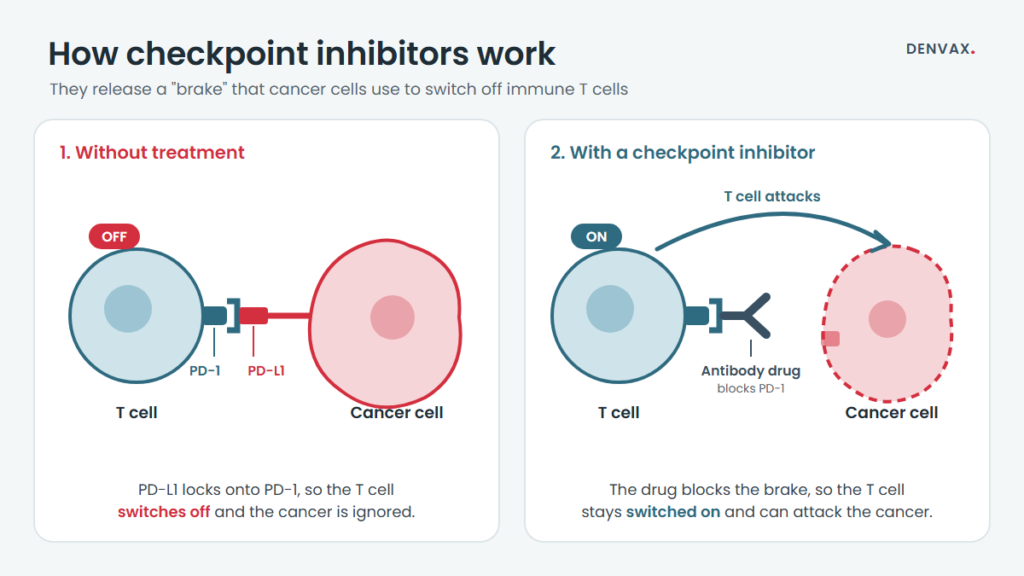
- Checkpoint inhibitors release “brakes” (PD-1, PD-L1 or CTLA-4) that cancers use to hide from the immune system.
- India’s list has grown quickly: toripalimab arrived in 2024, tislelizumab in 2025, and the first nivolumab biosimilars in 2026.
- Drugs that target the same brake are similar, but they are not automatically interchangeable.
- Biomarker tests (PD-L1, MSI/MMR, TMB) often decide whether a checkpoint inhibitor is likely to help.
On this page
What are checkpoint inhibitors?
Your immune system has built-in “checkpoints”: proteins that stop T cells from attacking healthy tissue. Many cancers exploit these checkpoints to switch off the T cells that would otherwise destroy them.
Checkpoint inhibitors are antibody medicines that block these signals so the immune response can work again. You can read more in our guide to how checkpoint inhibitors work.
There are three main groups:
- PD-1 inhibitors: block PD-1 on T cells (pembrolizumab, nivolumab, toripalimab, tislelizumab, cemiplimab, dostarlimab).
- PD-L1 inhibitors: block PD-L1 on cancer cells (atezolizumab, durvalumab, avelumab).
- CTLA-4 inhibitors: act earlier in T-cell activation (ipilimumab, tremelimumab).
Checkpoint inhibitors available in India (2026)
| Drug (brand) | Target | Company | Examples of cancers treated | India status |
|---|---|---|---|---|
| Pembrolizumab (Keytruda) | PD-1 | MSD | Lung, melanoma, head and neck, bladder, kidney, cervical, triple-negative breast, stomach, oesophageal, MSI-high cancers | Available |
| Nivolumab (originator) | PD-1 | BMS | Lung, melanoma, kidney, head and neck, oesophageal, stomach, Hodgkin lymphoma | Available |
| Nivolumab biosimilar (Tishtha) | PD-1 | Zydus | As approved for the biosimilar | Launched January 2026 |
| Nivolumab biosimilar (Nivorz) | PD-1 | Dr. Reddy’s | As approved for the biosimilar | Launched 2026 |
| Atezolizumab (Tecentriq) | PD-L1 | Roche | Small cell lung cancer, non-small cell lung cancer, liver cancer (with bevacizumab) | Available (first DCGI approval 2019) |
| Durvalumab (Imfinzi) | PD-L1 | AstraZeneca | Stage 3 lung cancer after chemoradiation, small cell lung cancer, biliary tract cancer | Available |
| Toripalimab (Zytorvi) | PD-1 | Dr. Reddy’s | Nasopharyngeal cancer (2024), advanced oesophageal squamous cell cancer with chemotherapy (October 2026) | Available |
| Tislelizumab (Tevimbra) | PD-1 | Glenmark | Non-small cell lung cancer, oesophageal squamous cell cancer (specific lines of treatment) | Reported launched 2025 |
| Ipilimumab, avelumab, cemiplimab, dostarlimab | CTLA-4 / PD-L1 / PD-1 | Various | Melanoma, kidney, skin, endometrial and other cancers | Check current availability with your oncologist |
Indian approvals sometimes cover fewer cancers than the same drug’s approvals in the US or Europe. The approved uses for each drug in India should be checked against its current Indian prescribing information.
Which checkpoint inhibitor for which cancer?
Lung cancer
Pembrolizumab, nivolumab, atezolizumab, durvalumab and tislelizumab all have lung cancer approvals. The choice depends on whether the cancer is small cell or non-small cell, its stage, the PD-L1 level, and whether it has driver mutations such as EGFR or ALK. Patients with these mutations usually start on targeted tablets instead. See also immunotherapy for lung cancer.
Head and neck cancer
Pembrolizumab and nivolumab are used for recurrent or metastatic disease. Toripalimab is approved in India specifically for nasopharyngeal cancer. Read immunotherapy for head and neck cancer.
Oesophageal and stomach cancer
Nivolumab, pembrolizumab, tislelizumab and, since October 2026, toripalimab have approvals in India for oesophageal squamous cell carcinoma in defined settings. Approvals for stomach cancer depend on PD-L1 results.
Liver cancer
Atezolizumab combined with bevacizumab is a standard first-line option for advanced hepatocellular carcinoma. Durvalumab-based regimens are also used. See immunotherapy for liver cancer.
Kidney, bladder and skin cancers
These are among the cancers that respond best to checkpoint inhibitors. Nivolumab, often with ipilimumab, and pembrolizumab are widely used.
Cancers with MSI-high or dMMR results
Tumours with mismatch-repair deficiency often respond well to PD-1 inhibitors, whatever organ they start in. This is why biomarker testing matters.
How doctors decide whether you are a candidate
- Biomarker tests: PD-L1 expression (reported as TPS or CPS), MSI/MMR status, and sometimes tumour mutational burden (TMB).
- Driver mutations: lung cancers with EGFR or ALK changes usually get targeted therapy first.
- Overall health: performance status, and existing autoimmune disease, organ transplant or long-term steroid use.
- Earlier treatment: some approvals are for first-line use, others only after chemotherapy.
Our immunotherapy eligibility guide explains these factors in more detail.
Side effects to know about
Checkpoint inhibitors can cause immune-related side effects, in which the activated immune system inflames healthy organs. Common examples:
- Thyroid problems (under- or over-active thyroid)
- Skin rash and itching
- Diarrhoea or colitis
- Liver inflammation (hepatitis)
- Lung inflammation (pneumonitis)
Most are mild and treatable, but some need urgent steroid treatment. Tell your team about any new symptom, even weeks after a dose. More in immunotherapy side effects.
Cost of checkpoint inhibitors in India
Prices vary widely by drug and dose. As examples from published sources in 2026:
- A 100 mg vial of pembrolizumab has an MRP of roughly ₹1.85–2.17 lakh (see our Keytruda price guide).
- The nivolumab biosimilar Tishtha was launched at ₹28,950 per 100 mg vial.
For a full breakdown of what affects the total, read our immunotherapy cost guide.
Checkpoint inhibitors and dendritic cell therapy
Checkpoint inhibitors work by removing the brakes on T cells that already recognise the cancer. Dendritic cell therapy works at an earlier step: it uses the patient’s own dendritic cells to present tumour antigens and train T cells.
Because they act at different stages of the immune response, researchers worldwide are studying how the two approaches can be combined. At Denvax, dendritic cell immunotherapy is planned as an add-on to standard treatment. Your oncologist and our doctors can discuss whether it fits your plan.
Book a consultation or call 1800 123 1132 (toll-free).
Frequently asked questions
Which immunotherapy drugs are available in India?
As of October 2026, checkpoint inhibitors available in India include pembrolizumab, nivolumab (with biosimilars), atezolizumab, durvalumab, toripalimab and tislelizumab. CAR-T therapies (NexCAR19, Qartemi) and dendritic cell therapies are other forms of immunotherapy available in India.
Are PD-1 inhibitors interchangeable?
No. They work in a similar way, but each drug is approved for specific cancers based on its own trial results. Switching should only be done on your oncologist’s advice.
Is nivolumab biosimilar as good as the original?
Biosimilars are approved after showing no clinically meaningful difference from the reference medicine in quality, safety and effectiveness. Ask your oncologist whether a biosimilar is suitable for your cancer and approved indication.
Do checkpoint inhibitors work for every cancer?
No. Response rates vary widely by cancer type and biomarkers. Some cancers, such as melanoma, kidney cancer and MSI-high tumours, respond well. Others respond rarely to checkpoint inhibitors given alone.
References
- Dr. Reddy’s launches toripalimab in India for nasopharyngeal carcinoma, November 2024. Business Wire.
- Dr Reddy’s gets DCGI nod for Zytorvi (toripalimab) second indication in oesophageal cancer, October 2026. Business Standard.
- Zydus launches world’s first nivolumab biosimilar Tishtha in India, January 2026. Pharma India.
- Zydus vs Dr. Reddy’s: nivolumab biosimilar competition in India, 2026. PharmaTutor.
- CION Cancer Clinics. Tislelizumab (Tevimbra) in India: approval and cost. cioncancerclinics.com.
- CDSCO Subject Expert Committee (Oncology & Haematology) recommendations, July 2021. cdsco.gov.in.
- Review of indications of FDA-approved immune checkpoint inhibitors per NCCN guidelines. PMC7140028.
- National Cancer Institute. Immune checkpoint inhibitors. cancer.gov.
Medically reviewed by Dr Sharmin Yaqin, MBBS MD · Last updated: October 2026
This article is for general information only and is not medical advice. Drug availability and approved uses in India change over time. Always confirm treatment options with your treating oncologist.
- Keytruda (Pembrolizumab) Price in India 2026: Per Vial, Per Cycle & Total Cost
- Dendritic Cell Therapy Cost in India (2026): What You Pay For


