


Chemotherapy vs Immunotherapy: Key Differences, Which Is Better & Costs in India (2026)
If you or a loved one has been diagnosed with cancer, one of the first questions your oncologist will discuss is which treatment approach is right for you. Two of the most prominent options today are chemotherapy vs immunotherapy — and understanding the difference between them can be life-changing.
At Denvax India, we specialize exclusively in cancer immunotherapy. In this guide, Dr. Sharmin Yaqin & Dr. Jamal A. Khan walks you through how these two treatments work, how they compare, and how to determine which approach is appropriate for different cancer types.
What Is Chemotherapy?
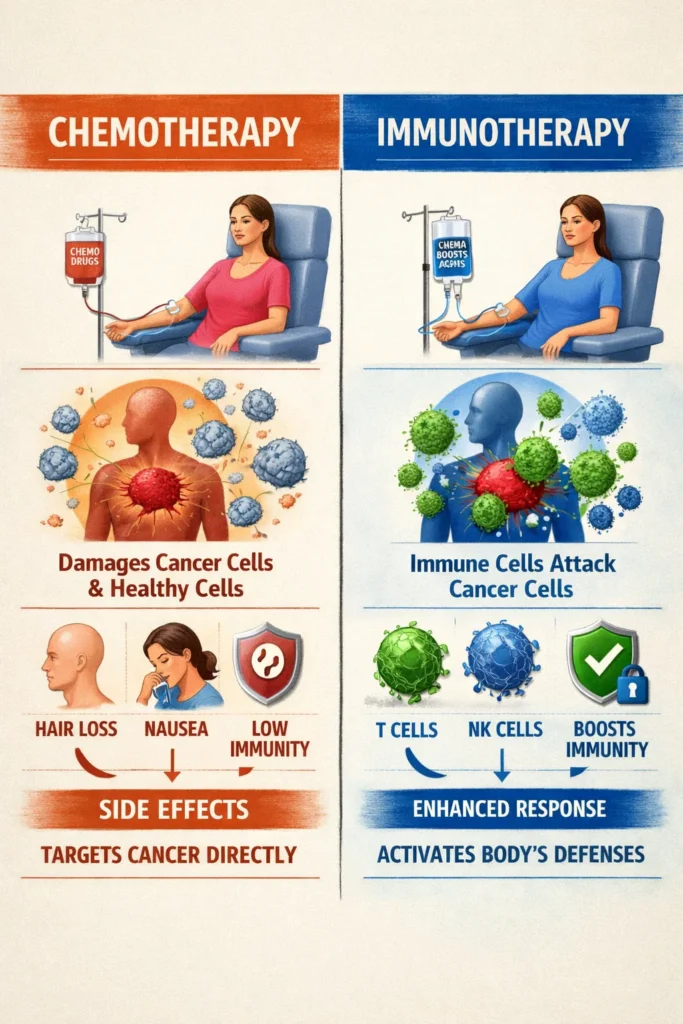
Chemotherapy is one of the oldest and most widely used forms of cancer treatment. It works by using powerful chemical agents to kill rapidly dividing cells throughout the body. Because cancer cells divide faster than most healthy cells, chemotherapy targets them preferentially — but it also damages healthy fast-dividing cells along the way, which is the root cause of most chemotherapy side effects.
Chemotherapy is administered in cycles — typically one treatment followed by a recovery period — repeated over several weeks or months. It can be given intravenously (IV drip), orally (pills), or in some cases topically or via injection.
How chemotherapy attacks cancer:
- Interferes with cancer cell DNA replication
- Disrupts cell division (mitosis)
- Induces apoptosis (programmed cell death) in rapidly dividing cells
- Can be used before surgery (neoadjuvant) to shrink tumors, or after (adjuvant) to eliminate remaining cells
What Is Immunotherapy?
Immunotherapy is a newer and increasingly powerful approach to cancer treatment that works by harnessing your own immune system to identify and destroy cancer cells. Rather than directly attacking the tumor with toxic chemicals, immunotherapy removes the “brakes” that cancer uses to hide from your immune defenses — or it actively trains your immune cells to recognize and attack the cancer.
At Denvax India, Dr. Sharmin Yaqin & Dr. Jamal A. Khan have pioneered immunotherapy protocols for Indian cancer patients across a wide range of cancer types.
Key types of immunotherapy include:
- Checkpoint inhibitors (e.g., pembrolizumab, nivolumab): Block proteins that cancer uses to “hide” from the immune system
- Dendritic cell therapy: Uses the patient’s own immune cells, trained to target their specific cancer
- CAR-T cell therapy: Genetically modifies T-cells to recognize and destroy cancer cells
- Cytokine therapy: Uses immune signaling proteins to amplify the immune response
- Cancer vaccines: Expose the immune system to cancer antigens to stimulate a targeted response
Chemotherapy vs Immunotherapy: Key Differences at a Glance
| Factor | Chemotherapy | Immunotherapy |
| Mechanism | Kills rapidly dividing cells directly | Activates the immune system to target cancer |
| Specificity | Non-specific — affects healthy cells too | More targeted — focuses on cancer cells |
| Side effects | Nausea, hair loss, fatigue, infection, organ toxicity | Fatigue, skin reactions, immune-related side effects |
| Treatment duration | Fixed cycles (typically 3–6 months) | Can continue for months to years as tolerated |
| Response durability | Often temporary — cancer may return | Durable “memory” responses — some patients achieve long-term remission |
| Cost in India | ₹30,000–₹2,50,000 per cycle | ₹1,50,000–₹5,00,000+ per cycle |
| Recovery time | Often difficult — frequent hospitalization | Many protocols are outpatient — better quality of life |
| Best suited for | Wide range of cancers, fast-growing tumors | Melanoma, lung, bladder, kidney, head & neck, blood cancers |
Side Effects: How Do They Compare?
This is often the deciding factor for patients and families. Understanding the side effect profile of each treatment is critical.
Chemotherapy Side Effects
Because chemotherapy affects all rapidly dividing cells — not just cancer cells — it commonly damages:
- Hair follicles → Hair loss (alopecia)
- Digestive tract lining → Nausea, vomiting, mouth sores
- Bone marrow → Reduced blood cell production, leading to fatigue, infection risk, and anemia
- Peripheral nerves → Numbness or tingling in hands and feet (neuropathy)
- Heart, liver, kidneys → Organ toxicity depending on the drugs used
These side effects are often severe enough to require hospitalization, dose reductions, or temporary treatment pauses. Quality of life during chemotherapy can be significantly affected.
Immunotherapy Side Effects
Immunotherapy side effects stem from immune overactivation rather than cell death. They are generally more manageable but can occasionally be serious:
- Fatigue — the most common side effect
- Skin reactions — rashes, itching, vitiligo-like pigment changes
- Inflammation — joints, lungs, liver, intestine, thyroid can become inflamed (called immune-related adverse events, or irAEs)
- Endocrine disruption — thyroid, adrenal gland issues
- Rare but serious — severe pneumonitis, colitis, or myocarditis in a small percentage of patients
The key difference: most immunotherapy side effects resolve with corticosteroids and dose adjustments. Chemotherapy side effects often persist throughout the treatment course.
Dr. Khan’s note: “In my clinical experience, patients on immunotherapy maintain a significantly better quality of life compared to chemotherapy patients. Many continue their normal daily activities during treatment — working, spending time with family, and avoiding the extreme fatigue that chemotherapy patients experience.”
Response Rates and Long-Term Outcomes
Chemotherapy Response Rates
Chemotherapy can be very effective at shrinking tumors rapidly, especially in aggressive, fast-dividing cancers. However:
- Remission rates vary widely by cancer type and stage
- Many cancers develop resistance to chemotherapy over time
- Recurrence after chemotherapy is common — the immune system remains uneducated about the cancer
- 5-year survival rates after chemotherapy alone are variable and often modest for advanced cancers
Immunotherapy Response Rates
Immunotherapy does not always produce rapid tumor shrinkage (some patients even experience initial “pseudo-progression” as immune cells flood the tumor site). However, what it offers is durability:
- Patients who respond to immunotherapy often maintain remission for years
- The immune system develops “memory” — it continues recognizing and fighting the cancer even after treatment stops
- Studies show that in melanoma, for example, some patients treated with checkpoint inhibitors remain disease-free for 10+ years
- In lung cancer, immunotherapy has doubled and tripled median survival in certain molecular subtypes
Important: Not all patients respond to immunotherapy. Biomarker testing (PD-L1 expression, tumor mutational burden, MSI status) helps identify who is most likely to benefit.
Cost Comparison in India
Cost is a critical factor for most Indian families making cancer treatment decisions. Here is a realistic breakdown:
Chemotherapy Costs in India
- Standard chemotherapy regimen: ₹30,000–₹2,50,000 per cycle
- Number of cycles: Typically 4–8 cycles (depending on protocol)
- Total cost (without surgery/hospitalization): ₹2,00,000–₹15,00,000
- Additional costs: Anti-nausea medication, hospitalization for infections, supportive care
- Government/insurance coverage: Many chemotherapy drugs are partially covered under Ayushman Bharat and major health insurance plans
Immunotherapy Costs in India
- Checkpoint inhibitors (PD-1/PD-L1 drugs): ₹1,50,000–₹4,00,000 per cycle (every 3–6 weeks)
- CAR-T cell therapy: ₹25,00,000–₹1,00,00,000+ (one-time but highly personalized)
- Dendritic cell therapy (as offered at Denvax): Costs vary by protocol — contact us for a personalized quote
- Insurance coverage: Yes Denvax has major Indian insurances.
While immunotherapy has a higher per-cycle cost, the potential for durable remission means fewer treatment cycles and reduced hospitalization costs over time. For many patients, the total cost of care over 5 years can be comparable — with significantly better quality of life outcomes.
For a detailed breakdown of immunotherapy costs, read our guide: Immunotherapy Cost in India.
Which Cancers Are Better Suited to Immunotherapy?
Immunotherapy is not yet the standard first-line treatment for all cancers, but it has shown exceptional results in:
- Melanoma — immunotherapy has transformed outcomes, with some patients achieving complete remission
- Non-small cell lung cancer (NSCLC) — checkpoint inhibitors have become standard, especially with high PD-L1 expression
- Bladder cancer — strong responses to PD-1/PD-L1 inhibitors
- Head and neck squamous cell carcinoma — significant survival improvements
- Kidney cancer (renal cell carcinoma) — combination immunotherapy is now the preferred first-line approach
- Hodgkin’s lymphoma — exceptional response rates (>80%)
- Colorectal cancer with MSI-H/MMR-d — excellent candidates for checkpoint inhibitors
- Triple-negative breast cancer — emerging data supports combination immunotherapy
Cancers where chemotherapy remains the primary standard:
- Most types of leukemia (though CAR-T has changed blood cancer treatment significantly)
- Small cell lung cancer (SCLC)
- Certain aggressive lymphomas
- Cervical, ovarian, and many GI cancers (though immunotherapy is emerging here too)
Can Chemotherapy and Immunotherapy Be Combined?
Yes — and increasingly, oncologists are combining both approaches for better outcomes. Chemotherapy can:
- Kill a large number of cancer cells rapidly, creating “debris” that makes cancer cells more visible to the immune system
- Reduce tumor burden enough for immunotherapy to finish the job
- Suppress regulatory T-cells that dampen immune responses against cancer
This combination approach, sometimes called “chemo-immunotherapy,” is now standard in several protocols (e.g., pembrolizumab + chemotherapy for first-line lung and cervical cancer).
At Denvax, Dr. Yaqin or Dr. Khan evaluates each patient’s case individually to determine whether monotherapy (immunotherapy alone) or a combination approach is optimal.
How to Know Which Treatment Is Right for You?
The decision between chemotherapy and immunotherapy is never one-size-fits-all. It depends on:
- Cancer type and subtype — certain cancers respond dramatically better to immunotherapy
- Stage — early-stage cancers may be curable with surgery alone; advanced cancers often require systemic treatment
- Biomarker status — PD-L1, TMB (tumor mutational burden), MSI status, and other markers indicate immunotherapy candidacy
- Performance status — immunotherapy may be preferred for patients who cannot tolerate chemotherapy’s toxicity
- Prior treatment history — patients who have failed chemotherapy may be excellent immunotherapy candidates
- Goals of care — cure vs. long-term disease control vs. quality of life
The best way to know whether immunotherapy is right for your specific case is to consult a specialist.
Frequently Asked Questions
Q: Is immunotherapy better than chemotherapy? A: Neither is universally “better” — the right choice depends on your cancer type, stage, molecular markers, and overall health. For many cancers, immunotherapy offers more durable responses with fewer side effects. For others, chemotherapy remains the standard of care. Your oncologist can guide you based on your specific case.
Q: Can I switch from chemotherapy to immunotherapy? A: Yes. Many patients who have received chemotherapy subsequently receive immunotherapy, especially if chemotherapy stops working or if immunotherapy was not initially indicated. This should be evaluated by a specialist based on current disease status and biomarker testing.
Q: Does immunotherapy work for all cancers? A: No. Immunotherapy works best in cancers that have specific molecular features (like high PD-L1 expression or high tumor mutational burden). Biomarker testing is essential to identify whether immunotherapy is likely to be beneficial for your specific cancer.
Q: Is immunotherapy available in India? A: Yes. India has access to several checkpoint inhibitor drugs, and specialized centres like Denvax India offer advanced immunotherapy protocols including dendritic cell therapy and CAR-T cell therapy coordination. Denvax India is one of India’s leading cancer immunotherapy specialists.
Q: How long does immunotherapy treatment last? A: This varies widely. Some patients receive immunotherapy for 1–2 years and then stop if they achieve complete remission. Others continue longer. Unlike chemotherapy, which follows a fixed schedule, immunotherapy is continued as long as the patient is benefiting and tolerating it.
Q: What are the chances of hair loss with immunotherapy? A: Hair loss (alopecia) is very uncommon with immunotherapy. This is one of the significant quality-of-life advantages over chemotherapy.
Talk to a Specialist Before Deciding
Choosing between chemotherapy and immunotherapy is one of the most important decisions a cancer patient will make. It deserves expert guidance, not a Google search alone.
At Denvax India, the team offers personalized consultations where your specific cancer type, stage, biomarker status, and health profile are all considered together. Our approach is never cookie-cutter — every treatment plan is tailored to the individual.
Book a consultation with Dr. Yaqin or Dr. Khan today: Schedule Your Appointment →
Or call us directly. A member of our team will reach out within 24 hours to confirm your appointment.
Disclaimer: This article is for informational purposes only and does not constitute medical advice. Always consult a qualified oncologist before making treatment decisions. For a personalized evaluation, book a consultation with Dr. Jamal A. Khan at Denvax India.
Related Articles:
- Can Immunotherapy Cure Stage 4 Cancer? What Patients in India Need to Know
- Dendritic Cell Therapy in India: A Complete Patient Guide (2026)